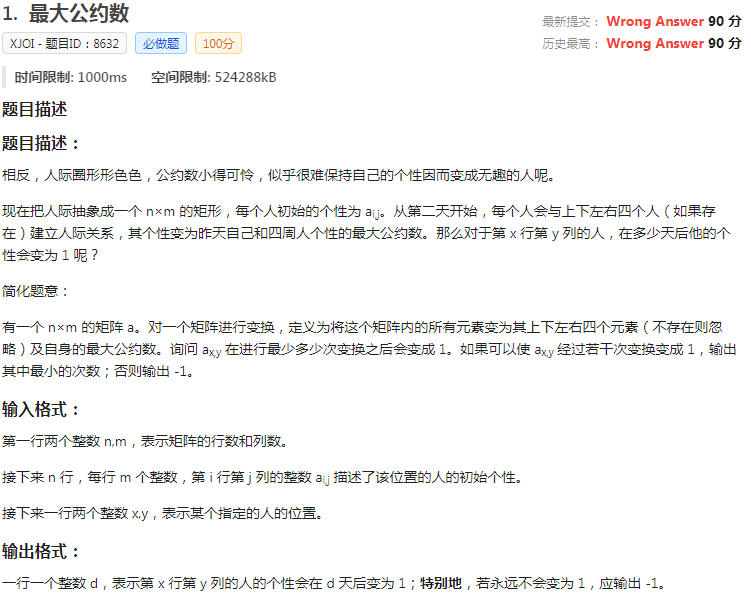

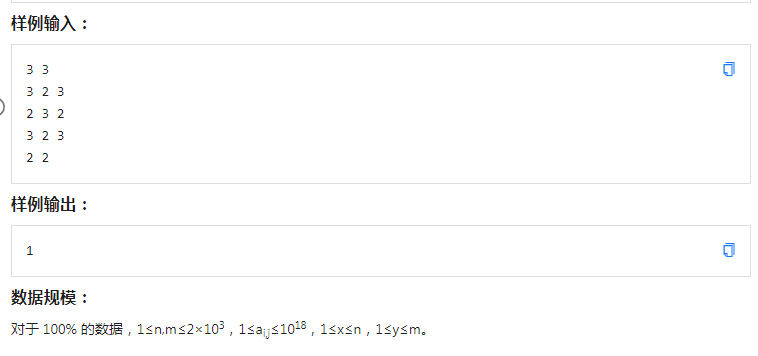
#include<bits/stdc++.h>
using namespace std;
int dx[4]={1,0,-1,0};
int dy[4]={0,1,0,-1};
long long n,m,a[2002][2002],vis[2002][2002],s,x,y,res;
struct node
{
	int x,y,ans;
};
queue<node>q;
void bfs()
{
	while(!q.empty())
	{
		node now=q.front();
		q.pop();
		res=__gcd(res,a[now.x][now.y]);
		if(res==1)
		{
			cout<<now.ans;
			return;
		}
		for(int i=0;i<4;++i)
		{
			int nx=now.x+dx[i];
			int ny=now.y+dy[i];
			if(nx>=1&&ny>=1&&nx<=n&&ny<=m&&!vis[nx][ny])
			{
				vis[nx][ny]=1;
				q.push({nx,ny,now.ans+1});
			}
		}
	}
}
int main()
{
	scanf("%lld%lld",&n,&m);
	for(int i=1;i<=n;++i)
	for(int j=1;j<=m;++j)
	{
		scanf("%lld",&a[i][j]);
		if(a[i][j]==a[1][1]) s++;
	}
	scanf("%lld%lld",&x,&y);
	if(s==n*m)
	{
		printf("-1");
		return 0;
	}
	s=0;
	vis[x][y]=1;
	res=a[x][y];
	q.push({x,y,0});
	if(res==1)
	{
		cout<<0;
		return 0;
	}
	bfs();
	return 0;
}
4 个赞
你的思路是对的
广搜:只要一个点变成1,输出step+1(这个点成为1除外)
然后提前判断掉-1的情况
3 个赞
一下是本蒟蒻的代码(大佬代码改不出来):
#include<bits/stdc++.h>
using namespace std;
template<class T>inline void read(T &x){x = 0;T f=1;char ch=getchar();while(ch<'0'||ch>'9'){if(ch=='-'){f=-1;}ch=getchar();}while(ch>='0'&&ch<='9'){x=x*10+ch-48;ch=getchar();}x*=f;}
long long a[2003][2003];
long long gcd(long long x, long long y){while(y^=x^=y^=x%=y);return x;}
int dx[5]={0, 1, 0, -1};
int dy[5]={1, 0, -1, 0};
struct node{
    int x, y,step;
}q[10000001];
bool vis[2001][2001];
int main(){
    int n, m;
    read(n);
    read(m);
    for(register int i=1; i<=n; ++i){
        for(register int j=1; j<=m; ++j){
            read(a[i][j]);
        }
    }
    int x, y;
    read(x);
    read(y);
    int head=1,tail=0;
    q[++tail]=(node){x,y,0};
    long long s=a[x][y];
    vis[x][y]=1;
    while(head<=tail){
        node h=q[head];
        head++;
        if(s==1){
            cout<<h.step;
            return 0;
        }
        for(int i=0;i<4;i++){
            int xx=h.x+dx[i];
            int yy=h.y+dy[i];
            if(xx>=1&&xx<=n&&yy>=1&&yy<=m&&!vis[xx][yy]){
                vis[xx][yy]=1;
                s=gcd(s,a[xx][yy]);
                if(s==1){
                    cout<<h.step+1;
                    return 0;
                }else{
                    node w=(node){xx,yy,h.step+1};
                    q[++tail]=w;
                }
            }
        }
    }
    cout<<-1;
}
3 个赞